Quick answer
You can rent out a Saskatchewan home from anywhere, and thousands of people do. Two things decide how complicated it gets. First, whether you are moving somewhere else in Canada or leaving Canada entirely, because those have completely different tax consequences. Second, who is physically here to open a door, meet a furnace tech, and stand in front of the Office of Residential Tenancies if a hearing gets scheduled.
Moving from Saskatoon to Calgary does not make you a non-resident of Canada and does not trigger 25% withholding on your rent. Moving to Dubai for two years might. That distinction is the single most misunderstood part of this, and it is covered in detail below.
About this guide. GoodDoors manages residential property in Regina and Saskatoon, and has managed 600+ properties across Saskatchewan since 2017. If you are reading this from somewhere else, you are in the majority of the owners who call us.47% of the owners who call us have already left Saskatchewan
GoodDoors reviewed 275 recorded sales conversations with prospective property owners in Regina and Saskatoon between May 2025 and July 2026. 130 of those owners no longer lived in Saskatchewan when they called: 98 elsewhere in Canada, and 32 outside the country entirely.
Managing a Saskatchewan rental from away is not an edge case here. It is close to half the demand. And 103 of the 275 had never rented out a property before, so the most common owner we speak to is a first-timer who has already left. These counts overlap, since most conversations involve more than one of these situations at once, and they come from what our salesperson wrote down after each call, which makes every one of them a floor rather than a ceiling.
Cutting the same conversations a different way: 67 of 275 were relocating and keeping the house rather than selling it, 14 of 275 named a job transfer specifically, usually on a timeline they did not choose, and 4 of 275 were snowbirds away for part of the year.
The destinations owners actually named are why this article splits the tax treatment the way it does. Within Canada: Calgary, Edmonton, Vancouver, Toronto, Ottawa, Winnipeg, and in-province Medicine Hat, Meadow Lake and North Battleford. Outside Canada: the United States, Mexico, Germany, Australia, Nigeria, China, Saudi Arabia, El Salvador, Jamaica. Everyone in the first list files a normal Canadian tax return. Some of the people in the second list do not.
What almost none of these owners mention is building a portfolio. They want the house handled while their life happens somewhere else. If you are still deciding whether to keep it at all, run the numbers in rent or sell first, and read the accidental landlord guide for the full first-year picture.
Out of province is not the same as non-resident of Canada
Get this one wrong and you either withhold money you never owed, or fail to withhold money the CRA will come looking for. They are two different situations with two different rulebooks.
If you move to another province, nothing changes on your tax return
Moving from Regina to Calgary, Toronto, Vancouver, or anywhere else in Canada does not make you a non-resident of Canada. There is no 25% withholding. There is no Section 216 election. You file a normal Canadian tax return and report the rental income and expenses on Form T776 exactly as you would if you still lived in the house.
The 25% Part XIII withholding regime and the Section 216 election apply to non-residents of Canada, not to people who left Saskatchewan. Part XIII is the tax a non-resident pays on Canadian-source income, and rental payments are on the list (CRA, Non-residents of Canada). The withholding and filing mechanics are set out at CRA, filing and reporting requirements. An owner in Alberta with a Regina rental is in the ordinary system.
What does change is the change of use on the property itself, and that happens whether you move across the country or across the street. When your home stops being your home and becomes a rental, the CRA treats it as a deemed disposition: "Every time you change the use of a property, you are considered to have sold the property at its fair market value (FMV) and have immediately reacquired the property for the same amount" (CRA, Principal residence and other real estate, under "Changes in use"). Nothing was sold, but the disposition, the designation, and any resulting gain have to be reported in the year the change of use happens. Read the relief that comes with it: if the property was your principal residence for any year you owned it before the change of use, you do not pay tax on the portion of the gain that relates to those years. For someone renting out the home they have been living in, that usually covers most of it.
If you leave Canada, the rules are different
If you become a non-resident of Canada for tax purposes, 25% Part XIII tax applies to rental income from Canadian real property, unless a tax treaty reduces the rate. Without an approved Form NR6, the payer or agent, which includes your property manager, must withhold 25% of the gross rent. Once the CRA approves Form NR6, the agent may instead withhold 25% of the net rent, after expenses (CRA, filing and reporting requirements).
That difference is large. Using Saskatoon's median asking rent of $1,472 (Zumper, August 2026) and example expenses you would replace with your own:
| Without approved NR6 | With approved NR6 | |
|---|---|---|
| Monthly rent collected | $1,472 | $1,472 |
| Deductible expenses (your own numbers) | not counted | $900 |
| Amount the 25% applies to | $1,472 gross | $572 net |
| Withheld and remitted monthly | $368 | $143 |
Two mechanics worth knowing before you leave:
- Form NR6 needs a Canadian-resident agent to sign it with you, and it is sent on or before January 1 each year, or before the first rental payment is due (CRA, Form NR6). If you are moving in November for a January 1 tenancy, that agent has to be lined up before you go.
- Filing an NR6 shortens your own deadline, it does not extend it. A Section 216 return is generally due within two years of the end of the year the rental income was paid or credited, but where the CRA approved your NR6 for a year, the Section 216 return for that year is due on or before June 30 of the following year (CRA, filing and reporting requirements and CRA, T4144). Do not plan around the two-year window if you have an approved NR6.
The two-year overseas posting is the case to think hardest about
The overseas posting described above, where you fully intend to come back and do not want to sell, has the most to gain and the most to lose here.
There is an election, under subsection 45(2) of the Income Tax Act, that lets a property keep its principal residence designation for up to four tax years while the election is in force, even though you are not living in it. Three conditions attach while it is in force: you cannot claim capital cost allowance on the property, you cannot designate any other property as your principal residence for those years, and you must be a resident or deemed resident of Canada during them (CRA folio S1-F3-C2). That last one is the condition this article's reader is most likely to fail. It is made by attaching a signed letter to your tax return describing the property and stating the election (CRA, Income Tax Folio S1-F3-C2 Principal Residence).
A two-year posting where you stay a Canadian resident for tax purposes gets a different outcome from one where you do not, and the election is tied to the year the change of use happens. A separate provision, section 54.1, removes the four-year cap altogether where an unrelated employer relocated you and you resume living in the home while still employed by that same employer, or by the end of the tax year after that employment ends. Two companies inside the same corporate group do not count as the same employer, so an internal transfer to a sister company can quietly fail the test. Which of those you are in is an accountant question, and it is worth asking before you fly rather than after. The full treatment of the election, the CCA trap, and how rental income gets reported is in our guide to rental income tax for Saskatchewan landlords.
What actually breaks when you are 1,500 km away
Distance does not make the work bigger. It makes a short list of things impossible, and those things arrive without warning.
- A furnace dies at minus 30. In a Saskatchewan January that is a same-day problem, and somebody has to get in the house.
- Showings. Filling a vacancy takes multiple people through the door at times that suit them, usually evenings and weekends.
- The ORT hearing. Disputes under The Residential Tenancies Act, 2006 go to the Office of Residential Tenancies, and you or someone authorized to act for you has to participate. A time zone is not an excuse the process accommodates.
- Service of documents. Notices have to be served properly, on time, using the right ORT form. Ending a tenancy has notice periods ranging from immediate for 15 or more days of arrears through two months for owner occupancy, and a service mistake resets the clock.
- The 7 business day deposit window. At the end of the tenancy you either return the security deposit, or file a claim through the Office of Residential Tenancies portal within 7 business days of the tenancy ending and serve it on every tenant. Filing through the portal is the step a remote owner is most likely to skip in favour of mailing a letter.
- Eyes on the building. Somebody local has to look at the property on a schedule, which is how you find the slow leak before it becomes the insurance claim.
The remote management stack
Whether you hire a manager or build this yourself, five things need an answer before you leave.
- Keys. Who physically holds them and what happens at 2am. A friend with a spare key and a full-time job is not a maintenance plan.
- Maintenance authority. A dollar limit under which work proceeds without calling you, and above which it does not. Without one you are either approving $80 invoices at midnight or discovering a $4,000 one.
- Documentation. A dated, photographed move-in condition report, and the same at move-out. This is your only defence in a deposit dispute you will attend by phone.
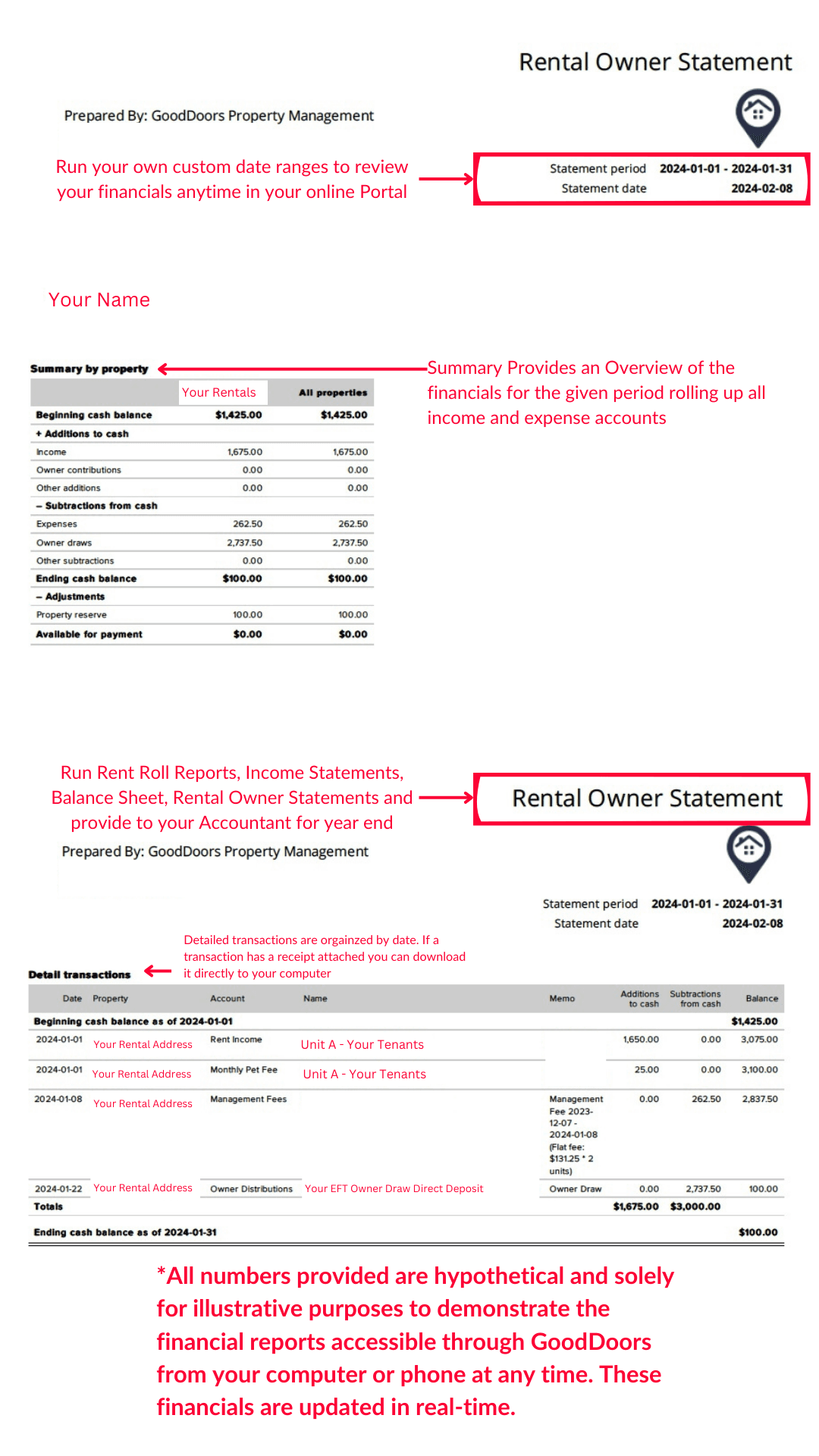
- Money. You should be able to see rent received, expenses paid, and net owner distribution each month without asking anyone.
- Screening. The tenant is the whole risk, and distance makes recovery from a bad placement slower and more expensive. That raises the value of proper tenant screening before anyone signs.
Time the lease around your move, not the other way around
If you have any control over the sequence, lease the house before you leave. Being here for the make-ready, the photos, and the first showings is worth more than any tool.
August is the strongest leasing window of the year in both cities and it closes in late September. Owners relocating in the fall often aim for a September 1 tenancy, which is the right instinct. Properly priced and well presented, a unit currently takes about 21 to 30 days from listing to lease, so that means listing in early August, not late August. The seasonal picture and the break-even math on holding out for higher rent are in our guide to fall leasing season.
One more thing to set before you go: the lease end date. A lease that ends in January puts your next turnover in the worst month of the year. Set it to end in summer.
For pricing, work from the current market rather than from what you paid. Regina's median asking rent is $1,389 and Saskatoon's is $1,472 (Zumper Regina and Zumper Saskatoon, August 2026), against purpose-built apartment vacancy of 2.7% in Regina and 3.3% in Saskatoon in CMHC's October 2025 survey. If you are renting out a house rather than a condo, the segment you are actually competing in is tighter and dearer: in the same survey CMHC's average three-bedroom-plus rent was $1,958 in Regina and $1,732 in Saskatoon, and Regina's three-bedroom-plus vacancy fell to 1.4% (CMHC Rental Market Reports).
Insurance and the mortgage: two calls to make before you go
Call your insurer. A homeowner policy is written for an owner-occupied house, and yours is about to stop being one. The Insurance Bureau of Canada draws a distinction that matters here: a home is "unoccupied" when your contents are still there and you are temporarily away, and "vacant" when the occupants have moved out with no intention of returning, or no new occupant has moved in (IBC, insurance glossary). If you move out in December and a tenant moves in March, that gap is the part your insurer needs to know about.Rented properties carry different risks than owner-occupied homes (IBC, types of home insurance coverage). Landlord coverage "replaces your lost rental income if tenants must vacate the premises due to damage from an insured loss", and IBC advises that a rental agreement should require tenants to buy tenant insurance and provide proof of it annually (IBC, Are you a landlord?). Do both.
Coverage limits and the exact definition of vacancy vary by insurer and by policy, so phone your own insurer twice: before the house sits empty, and before a tenant moves in. Do not rely on a threshold you read online.
Call your lender. Occupancy terms are in your mortgage contract and they differ by lender, so ask before the tenancy starts rather than after.When self-managing from away still works
It genuinely does sometimes, and anyone telling you otherwise is selling something. Self-managing from a distance is reasonable when most of these are true:
- You moved to a nearby city, not across the country. Saskatoon to Regina is a drive. Saskatoon to Ottawa is not.
- You have one unit, in good condition, with a tenant already in place who you trust.
- Family or a close friend in town can genuinely respond, and you have asked them properly rather than assumed.
- You are comfortable with the paperwork: a compliant written lease, condition reports, ORT forms, and the deposit deadlines.
If you would rather hand this to someone who is actually here, GoodDoors Property Management is SREC-licensed, has managed property in Regina and Saskatoon since 2017, and can act as your Canadian agent on the paperwork if you end up on the non-resident side of the line.
This is general information, not tax or legal advice. Confirm your own situation with your accountant, and confirm tenancy questions with the Office of Residential Tenancies.For an estate, add a clear plan for who authorizes spending and how ownership will transfer. Our estate rental guide covers those steps before the first tenancy.
Frequently Asked Questions
Do I pay 25% withholding tax if I move to another province and rent out my Saskatchewan house?
No. The 25% Part XIII withholding applies to non-residents of Canada, not to Canadians who move between provinces. If you move from Saskatoon to Calgary, Toronto, or Vancouver, you file a normal Canadian tax return and report the rental income on Form T776 exactly as you would have living in Saskatchewan.
What happens if I become a non-resident of Canada and rent out my home?
25% Part XIII tax applies to your rental income from Canadian real property unless a tax treaty reduces the rate. Without an approved Form NR6 the payer or agent must withhold 25% of the gross rent; once the CRA approves the NR6, the agent may withhold 25% of the net rent after expenses instead. A Section 216 return is generally due within two years from the end of the year the income was paid or credited, but where the CRA approved your NR6 for that year the return is due on or before June 30 of the following year.
Who signs Form NR6 for a non-resident owner?
A Canadian-resident agent has to sign Form NR6 alongside you. It is sent on or before January 1 each year, or before the first rental payment is due. A property manager can act in that agent role, which is why it needs to be arranged before you leave rather than after.
Can I keep my principal residence exemption while I am away?
Possibly. The subsection 45(2) election can preserve the principal residence designation for up to four tax years while the election is in force, but three conditions attach: no capital cost allowance on the property, no other property designated as your principal residence for those years, and you must be a resident or deemed resident of Canada during them. A separate provision, section 54.1, can remove the four-year cap where an unrelated employer relocated you and you resume living in the home while still employed by that same employer, or by the end of the tax year after that employment ends. Confirm with your accountant before you leave the country.
Do I need to tell my insurance company that I am renting out my house?
Yes, and call before the house sits empty as well as before a tenant moves in. A homeowner policy is written for an owner-occupied home, and insurers treat an "unoccupied" home differently from a "vacant" one. Coverage limits and definitions vary by insurer, so get your own answer rather than relying on a general rule.
Does my Saskatchewan property manager have to be licensed?
Yes, and it is worth checking before you leave the province. Negotiating or approving a lease of your property, or holding the rent money, is property management under s. 2(r) of The Real Estate Act and a trade in real estate under s. 2(bb)(iv); s. 18(1) prohibits trading as a brokerage without registration, and a property management agreement is defined as an agreement between a landlord and a brokerage (s. 2(s)) (The Real Estate Act, c R-1.3). You yourself need no licence to rent out your own house (s. 3(1)(a)). Ask whoever you hire for their Saskatchewan Real Estate Commission registration.
Can I manage a Saskatchewan rental from another province myself?
Yes, if the property is in good condition, already tenanted, and you have someone local who can genuinely respond to an emergency. It is much harder when the unit is empty and needs leasing, when a dispute goes to the Office of Residential Tenancies, or when a furnace fails in January and nobody has a key.