

I am the licensed Broker at GoodDoors Property Management, and I have been operating under The Residential Tenancies Act, 2006 in Regina and Saskatoon since 2017. This is the guide I wish existed when I started: not a summary of the statute, but the rules plus the part nobody writes down, which is how the Office of Residential Tenancies actually works when you have to use it.
Everything on this page is sourced to the Government of Saskatchewan or the Act itself. Where a number matters, I have given you the section or the form. Where the law is silent, I say so rather than filling the gap.
Last updated: August 2026. The most recent change to Saskatchewan tenancy legislation was The Residential Tenancies Amendment Act, 2021, in force September 15, 2021.Quick answer
The Residential Tenancies Act, 2006 and The Residential Tenancies Regulations, 2007 govern residential tenancies in Saskatchewan. The Office of Residential Tenancies, still widely called the Rentalsman, administers them. Tenancy agreements may be verbal or written. Security deposits are capped at one month's rent, and only half may be required when the tenancy is entered into. Rent increases in a periodic tenancy need 12 months' notice, or six months if the landlord belongs to a prescribed association. Every application to the ORT costs a non-refundable $50 and hearings are held by phone.
Tenancy agreements: what the Act requires
A Saskatchewan tenancy may be periodic (weekly or monthly) or fixed term (three months up to less than 20 years), and it may be verbal or written. A verbal tenancy is a real tenancy. I mention that first because I still meet owners who believe an unsigned arrangement is unenforceable, and it is not.
Schedule 1, Standard Conditions of a Tenancy Agreement, applies to every tenancy in the province whether or not anyone signed anything.
On a verbal tenancy, within 20 days of the start date the landlord must give every tenant the landlord's or agent's address for service and phone number, an emergency phone number, and a copy of Schedule 1. On a written tenancy, a signed copy goes to every tenant within 20 days of the start date, and the agreement must include all of the following:- a copy of Schedule 1
- legal names of landlords and tenants
- the rental unit address
- the tenancy agreement date
- the landlord's or agent's service address and phone number
- the landlord's or agent's emergency phone number
- the tenancy start date
- the type of tenancy, periodic or fixed term
- the tenancy end date, if fixed term
- the amount of rent payable
- the day of the month rent is due
- who pays which utilities
- which services and facilities are included in the rent
- the amount of any security deposit and the date it was or must be paid
Fixed-term tenancies must state an end date. At least two months before that date the landlord must serve the Term Lease, Two Month Notice of Intention Form setting out their intentions for renewal. The tenant then has one month to agree in writing. No written agreement from the tenant means the tenant vacates at the end of the term.
Full detail on drafting one: Saskatchewan lease agreement rules and what to include.
Security deposits

The cap is one calendar month's rent. At the date the tenancy is entered into a landlord may require no more than 50% of that, with the remainder payable within two months of the tenant taking possession.
This is the single most common mistake I see on a first tenancy. An owner collects the full deposit at signing because that is how it works in other provinces, and they are offside on day one.
Deposits must be invested in securities authorized by The Trustee Act, 2009 or held in a trust account at a bank, trust company or credit union. Interest stays payable to the tenant only on tenancies running over five years, and it accrues only up to 30 days after the tenancy ends.
A landlord may not write a clause saying they automatically keep the deposit at the end. That clause is void.
Two deadlines that get confused constantly, because they belong to different parties:
| Party | Action | Deadline |
|---|---|---|
| Landlord | Claim all or part of the deposit, through the ORT portal, served on every tenant at the service address they gave | Within seven business days of the tenancy ending |
| Tenant | Dispute the landlord's claim, or apply for return of the deposit | Within 60 days of the tenancy end date |
More on the mechanics: Saskatchewan security deposit rules.
Every notice, with its form and its timeline
These come straight from the ORT's own tables. The old form numbers are still how most people refer to them, and the portal now names them in words instead.
Landlord notices
| Section | Old form | Notice in the portal | Tenancy | Timeline |
|---|---|---|---|---|
| s. 45 | Form 4 | Notice of Entry | Either | 24 hours to seven days |
| s. 54 | Form 5 | Notice of Rent Increase | Periodic | 12 months |
| s. 54 | Form 5a | Notice of Rent Increase for Prescribed Landlord Association Members | Periodic | Six months |
| s. 57 | Form 7 | Immediate Notice to Vacate and Notice of Arrears | Either | Immediate, once the tenant is 15 days in arrears |
| s. 57(5)(b) | Form 7a | Notice of Utility Arrears | Either | 15 days |
| s. 58 | Form 8 | Evictions Requiring Notice of One Calendar Month | Either | One month |
| s. 59 | Form 8a | Notice to Vacate, Employee | Either | One month |
| s. 60(4) and (5) | Form 8b | Notice to Vacate so Owner can Occupy | Periodic | Two months |
| s. 60(6) | Form 8c | Notice to Vacate so Purchaser can Occupy | Periodic | One month |
| s. 60(7) | Form 8d | Notice to Vacate for Specified Uses | Periodic | Two months |
| s. 60(7.1) | Form 8e | Notice to Vacate for Housing Program Purposes | Periodic | One month |
| s. 32 | Form 13/14 | Keep all or some of the tenant's security deposit | Either | Within seven business days of the tenancy end date |
| Reg. s. 8.2 | Form 15 | Term Lease, Two Month Notice of Intention Form | Fixed term | Two months before the end date |
Tenant notices
| Section | Old form | Notice in the portal | Tenancy | Timeline |
|---|---|---|---|---|
| s. 56 | Form 6 | Notice to Landlord to Terminate the Tenancy | Periodic | One month |
| s. 56(2) | Form 6a | Tenant's Notice to Vacate Early for Cause | Either | Less than one month |
Every notice must carry legal names, the rental address, the date the tenancy ends, and the grounds. Deeper on the eviction path: Saskatchewan eviction laws and notice periods.
Rent increases
 Periodic tenancies. A landlord who does not belong to a prescribed association serves a 12-month Notice of Rent Increase from the portal. The increase may not begin within the first 18 months of the tenancy start date, and rent may be increased only once every 12 months.
Prescribed association members. Landlords in good standing with the Network of Non-Profit Housing Providers of Saskatchewan Incorporated or the Saskatchewan Landlord Association Inc. may serve a six-month notice. The increase may not begin within the first 12 months of the tenancy start date, and may be raised once every six months.
Fixed-term tenancies. Rent may be increased by a percentage or a dollar amount as set out in the written agreement, or through the Term Lease, Two Month Notice of Intention Form served at least two months before the end date. The tenant has 30 days to accept the new terms in writing or to vacate by the end date.
Periodic tenancies. A landlord who does not belong to a prescribed association serves a 12-month Notice of Rent Increase from the portal. The increase may not begin within the first 18 months of the tenancy start date, and rent may be increased only once every 12 months.
Prescribed association members. Landlords in good standing with the Network of Non-Profit Housing Providers of Saskatchewan Incorporated or the Saskatchewan Landlord Association Inc. may serve a six-month notice. The increase may not begin within the first 12 months of the tenancy start date, and may be raised once every six months.
Fixed-term tenancies. Rent may be increased by a percentage or a dollar amount as set out in the written agreement, or through the Term Lease, Two Month Notice of Intention Form served at least two months before the end date. The tenant has 30 days to accept the new terms in writing or to vacate by the end date.
Saskatchewan has no rent control. The Act sets the notice and the frequency, not a cap on the amount. Worked examples: Saskatchewan rent increase law.
Entry, quiet enjoyment and the rules a landlord can set
A landlord may enter with written notice given at least 24 hours and not more than seven days before the intended entry, using the Notice of Entry. Entry without that notice is limited to an emergency, an ORT order permitting it, or a unit the tenant has abandoned.

Tenants hold the right to quiet enjoyment, which in practice means privacy, freedom from unreasonable disturbance, reasonable use of common areas, and exclusive use of the unit subject to the landlord's right of access. A landlord cannot bar a tenant, or someone the tenant has permitted, from the property during the tenancy.
Two access rights people forget: revising agents and enumerators carrying out duties under The Election Act, 1996, and candidates or their representatives under The Local Government Election Act, 2015. Tenants may also display election advertising during a campaign.
A landlord may impose additional rules covering use of services and facilities, and use, occupancy or maintenance of the property, including rules on cannabis in the unit. Those rules bind the tenant only if they are reasonable, delivered in writing, and known to the tenant. Put them in the agreement.
How the Office of Residential Tenancies actually works
This is the section I could not find anywhere when I started, so here it is from the inside. Everything runs through the ORT's online portal now.
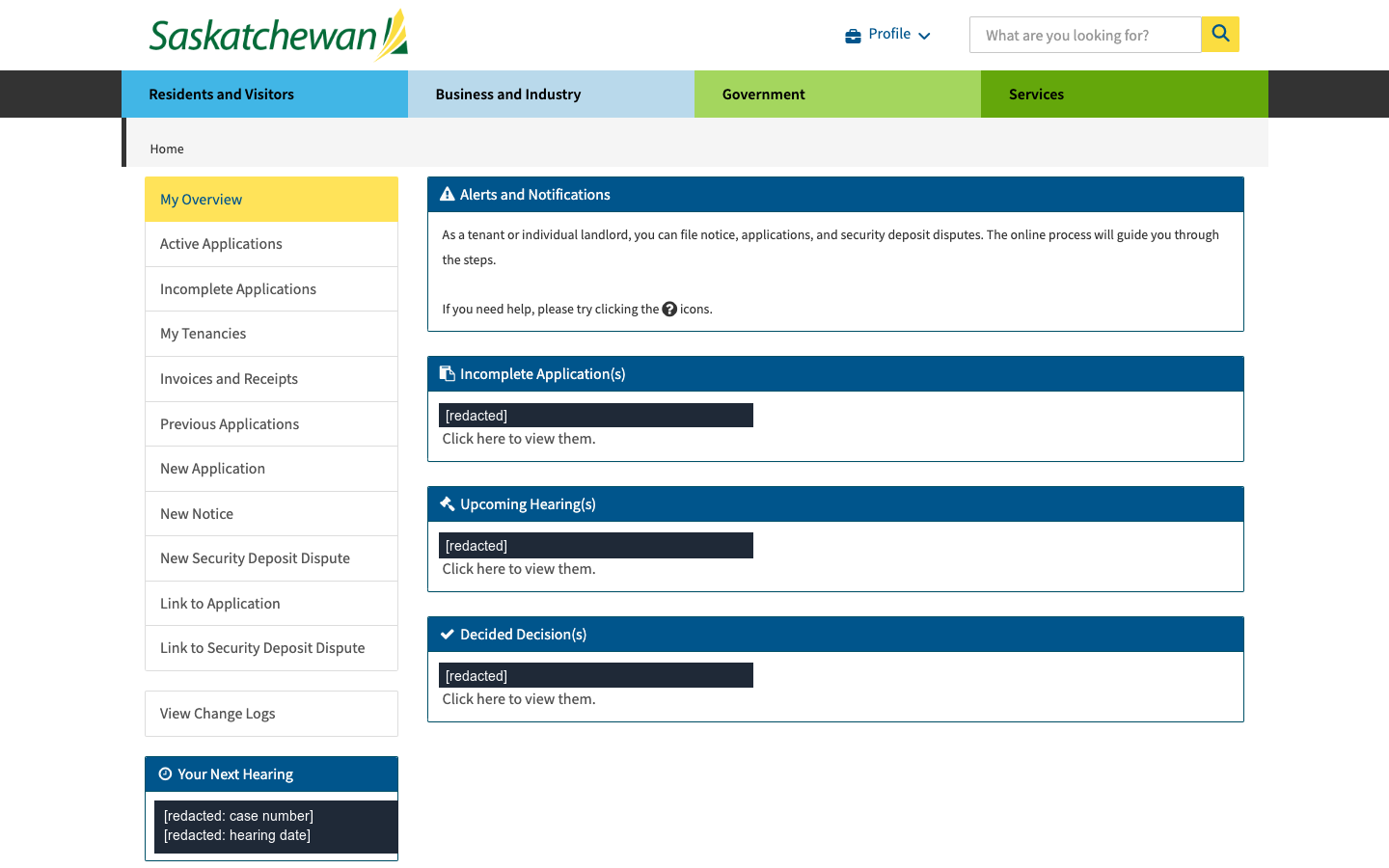
That is the portal dashboard as a landlord sees it. The left column is the whole system: your active and incomplete applications, your tenancies, invoices and receipts, and the four things you can start, which are a New Application, a New Notice, a New Security Deposit Dispute, and a link to an application somebody else started.
Before you apply
The ORT asks both parties to try to resolve the matter directly first, and to do it in writing, because that correspondence becomes evidence if it does go to a hearing. That is not a formality. A calm written record of what you asked for and when is the single most useful thing you can bring to a hearing.
ORT staff answer landlord and tenant questions during business hours on 1-888-215-2222, and there are offices in both Regina and Saskatoon. The mailing address is 304, 1855 Victoria Avenue, Regina, SK, S4P 3T2.
Which application, and by when
| Section | Old form | Who files | Portal path | Deadline |
|---|---|---|---|---|
| s. 85 | Form 2 | Landlord | New Application > Landlord > Property Disposition Order | After the tenancy ends, up to one year |
| s. 70 | Form 9 | Tenant | New Application > Tenant > claim reason | During the tenancy, or up to one year after the act or omission |
| s. 70 | Form 9a | Landlord | New Application > Landlord > claim reason, notice served | During a tenancy |
| s. 70 | Form 9b | Landlord | New Application > Landlord > claim reason, no notice served | During a tenancy |
| s. 70 | Form 9c | Landlord | New Application > Landlord > Monetary Claim | During the tenancy, or up to one year after the act or omission |
| s. 70 | Form 9d | Landlord | New Application > Landlord > Other claim | During a tenancy |
| s. 70 | Form 12 | Tenant | New Security Deposit Dispute > landlord has not returned the deposit | Within 60 days of the tenancy end date |
| s. 70 | Form 13/14 | Tenant | New Security Deposit Dispute > Notice of Landlord's Claim | Within 60 days of the tenancy end date |
The seven steps
- Sign in to the ORT portal.
- Select New Application.
- Select Landlord or Tenant, and whether you are the applicant or filing on someone's behalf.
- Select the application type, enter the tenancy information and upload the documents. Legal names are required.
- Submit for ORT staff review.
- Once approved, the status changes to Payment Required. Pay the non-refundable $50 fee in the portal.
- Staff schedule the hearing and send the hearing notice by email or mail.
Serving the other side
Proof of service is required, and which methods are open to you depends on who you are serving.
| Serving | Personal | Posting and electronic | Posting and ordinary mail | Electronic | Ordinary mail |
|---|---|---|---|---|---|
| Current tenant | yes | yes | yes | ||
| Former tenant | yes | yes | |||
| Landlord | yes | yes | yes |
If you are the respondent, the hearing notice comes with a link code that connects you to the application in the portal so you can upload your own evidence.
Evidence and the hearing
All evidence goes into the portal and must also go to the other party using the service methods above. The ORT asks for evidence that is legible, unaltered, and limited to the claims actually being made. In practice that means the tenancy agreement, the written correspondence, receipts, photos and video.
Hearings are held by phone. The hearing notice tells each party to call the ORT beforehand with the number they can be reached at, and the hearing officer calls those numbers at the appointed time. Do not have 1-800 numbers blocked, which is a small detail that has cost people their hearing.The ORT does not publish an average wait time between filing and hearing, so I will not invent one.
Decisions, corrections and appeals
The hearing officer issues a written decision and order, emailed or mailed to both parties. Keeping your contact details current in the portal is on you.
- Obvious error or something unclear: either party may email a Request to Correct or Clarify a Decision or Order within 15 days of the decision date. Another non-refundable $50. It goes back to the same hearing officer.
- Appeal: to the Court of King's Bench within 30 days of the decision date. A tenant appealing a rent or utility arrears claim, or a continuous late payment claim, must include a Certificate of Payment of Rent and pay the equivalent of one month's rent into the ORT, held in trust until the appeal concludes.
- Enforcement is yours. The ORT does not collect for you. After the 30-day appeal window passes, an order may be registered as a judgment of the Court of King's Bench. Only a sheriff enforcing a Writ of Possession may remove a tenant. If anyone else tries, the tenant should call the police.
What I see landlords get wrong
Collecting the whole deposit at signing. Half at the outset is the maximum, and the rest is due within two months of possession. Treating a verbal tenancy as no tenancy. It is a tenancy, and the 20-day obligation to hand over your service address, an emergency number and Schedule 1 still applies. Missing the two-month fixed-term notice. The Term Lease, Two Month Notice of Intention is what preserves your position at the end of a fixed term. Miss it and you have lost the clean exit you assumed you had. Serving the right notice for the wrong reason. The reason drives the form and the timeline. Owner occupancy is two months on a periodic tenancy, purchaser occupancy is one, arrears is immediate at 15 days. A well-drafted notice under the wrong section fails. Not keeping the written trail. Everything the ORT weighs at a hearing is a document. The conversation you had at the door is not evidence.Almost all of these come from the same place. The owner did not set out to be a landlord, so nobody ever walked them through the Act. If that describes you, start with the accidental landlord's guide to Saskatchewan, or with what to do when you inherit a house here if the property came out of an estate. If you have not decided whether to keep it at all, rent or sell works the break-even math for both cities.
The rest of the cluster
Each of these goes deeper than this page does on one piece of the Act.
- Saskatchewan lease agreement rules, plus a free template
- Security deposits: collection, trust accounts and claims
- Eviction laws and the notice each ground requires
- Rent increase law, with worked examples
- Breaking a lease agreement early
- Ending a tenancy cleanly
- Saskatchewan eviction notice: what goes on the form
- Saskatchewan rent increase notice generator
Sources
- Government of Saskatchewan: Settling Disputes and Steps to a Hearing
- Government of Saskatchewan: Security Deposits
- Government of Saskatchewan: Ending a Tenancy
- Government of Saskatchewan: Tenancy Agreements
- Government of Saskatchewan: Rent Increases
- Government of Saskatchewan: Office of Residential Tenancies
- The Residential Tenancies Act, 2006, SS 2006, c R-22.0001
Frequently Asked Questions
How much notice does a landlord have to give a tenant to move out in Saskatchewan?
It depends on the reason. One calendar month for the evictions under section 58 and for a notice to vacate served on an employee. Two months for owner occupancy or for specified uses on a periodic tenancy. One month for purchaser occupancy or housing program purposes. Immediate, once the tenant is 15 days in arrears, using the Immediate Notice to Vacate and Notice of Arrears. In serious circumstances a landlord may apply for possession without serving notice first, but the ORT requires significant evidence.
What are the renters' rights in Saskatchewan?
Quiet enjoyment of the unit, which covers privacy, freedom from unreasonable disturbance, reasonable use of common areas, and exclusive use of the unit subject to the landlord's right of entry on 24 hours' to seven days' written notice. Tenants are also entitled to a copy of Schedule 1 and the landlord's service and emergency contact details within 20 days of the start date, to a security deposit collected no more than half at the outset, and to apply to the ORT when those rights are breached.
What is the phone number for Rentalsman in Regina?
The Office of Residential Tenancies answers landlord and tenant inquiries at 1-888-215-2222 during regular business hours, and staffs offices in both Regina and Saskatoon. The mailing address is 304, 1855 Victoria Avenue, Regina, SK, S4P 3T2.
Where do I complain about a landlord in Saskatchewan?
Start with the landlord in writing, because that correspondence becomes evidence. If it does not resolve, file an application through the ORT online portal under section 70. The fee is $50 and non-refundable, and it is payable once ORT staff have reviewed and approved your submission.
Can a landlord evict a tenant in Saskatchewan?
Yes, with the notice the Act requires for the reason being relied on, and through the ORT rather than personally. If the tenant does not leave by the date in the notice, the landlord applies for possession and includes a copy of the served notice and the supporting evidence. Only a sheriff of the Court of King's Bench, enforcing a Writ of Possession, may remove a tenant.
How much can a landlord increase rent in Saskatchewan?
There is no cap. Saskatchewan does not have rent control, so the Act governs the notice and the frequency instead of the amount. On a periodic tenancy that means 12 months' notice, no increase within the first 18 months of the tenancy, and once every 12 months. Landlords in good standing with a prescribed association may give six months' notice, with no increase in the first 12 months and no more than once every six months.
What is classified as landlord harassment?
The Act does not use the word harassment. What it gives tenants is the right to quiet enjoyment and a restriction on entry to 24 hours' to seven days' written notice, except in an emergency, under an ORT order, or where the unit has been abandoned. Repeated entry without notice, interference with the tenant's exclusive use, or barring access are all breaches a tenant can bring to the ORT under section 70.
What are red flags for tenants?
From the screening side, the ones that predict trouble are an unwillingness to consent to a credit or reference check, an application that will not name a current landlord, income that cannot be verified, and pressure to sign or move in before screening finishes. On the tenant's side of the table, the equivalent red flags are a landlord who will not put the agreement in writing, will not give a service address or emergency number, or asks for the full security deposit at signing.
What not to say to your landlord?
The framing is wrong, and it is worth saying plainly because the question gets asked constantly. What matters is not what you avoid saying, it is that what you do say exists in writing. Verbal assurances in either direction carry almost no weight at a hearing. Put the request, the complaint or the agreement in an email, and keep the reply.
What is the minimum notice a landlord can give?
None, in two situations. Serious circumstances, where a landlord may apply for possession without serving notice first and must support it with significant evidence. And rent arrears, where an Immediate Notice to Vacate and Notice of Arrears may be served once the tenant is 15 days behind. Every other ground carries a set notice period, from one month up to two.