
We charge condominium corporations $40 per unit per month, plus GST, with a minimum of $960 a month, the fee for a 24 unit building. Every other charge we make is published in the rate card below, with who pays it and what it costs. If a fee is not on this page, it will not be on your statements.
This page is for condo boards in Regina comparing options before an AGM or a renewal.
What condo management costs: $40 per unit, $960 minimum
The monthly fee is the unit count times $40. The minimum is $960 a month, the fee for 24 units, so the minimum applies to any corporation under 24 units.
- 50 units: 50 times $40 is $2,000 a month.
- 60 units: 60 times $40 is $2,400 a month.
- 24 units: 24 times $40 is $960 a month, which is also the minimum.
- 12 units: 12 times $40 is $480, so the $960 minimum applies.
We set a minimum because the work a board needs done does not shrink much with the unit count. A 20-unit building still needs its vendor contracts quoted, its fees collected, its reports prepared and its AGM run.
The full condo rate card
Every line below is part of the management agreement you sign. Amounts are in Canadian dollars.
| Item | What it covers | Who pays | Price |
|---|---|---|---|
| Monthly management | Condo fee collection by EFT or card, the monthly board report, every vendor contract retendered every year, owner notices by email, SMS and the portal, a board-only document folder, the AGM financial, reserve fund and insurance reports | Corporation | $40 per unit per month, $960 a month minimum (the fee for 24 units) |
| Board meetings | Up to 4 a year, on site or online | Corporation | Included |
| AGM | Notice, the meeting itself and the minutes | Corporation | Included |
| Extra meetings | Board meetings beyond the 4, and special general meetings | Corporation | $125 an hour |
| Setup when you switch to us | Records, accounts, owner setup and the portal | Corporation | $0 |
| Vendor work: snow, landscaping, cleaning, repairs | The vendor is paid from the corporation's budget. We hire, schedule and pay them as part of the monthly fee | Corporation | The vendor's bill only, no markup |
| Quotes and retendering | Three quotes on every contract, every year | Corporation | Included |
| Reserve fund study | Tendering the study, and working with the qualified person who does it | Corporation | Included (the study itself is the consultant's fee) |
| Capital projects | Roofs, building envelope, parking lots: bids, contract, schedule, oversight | Corporation | 5% of the contract on projects over $10,000. $125 an hour on smaller projects |
| Special assessment | Notices, collection and tracking | Corporation | $125 an hour |
| After-hours emergency | Coordinating an emergency outside business hours | Corporation | $97.50 a call |
| Estoppel certificate (Form GG) | Issued when a unit sells | Selling owner | $200, the provincial maximum (Regs s 66.1(2)). GoodDoors keeps it for preparing the certificate. The corporation pays nothing |
| Other resale documents | Bylaws, financial statements, budget, reserve fund study, a copy of the management agreement | Owner requesting | Cost of producing them (Regs s 66) |
| Mailed paper notices | For an owner who wants paper instead of email | That owner | $25 per mailing |
| Collections on arrears | Demand letters and lien work on an unpaid account | Owner in arrears, if the corporation's bylaws allow it. Otherwise the corporation | $125 an hour plus legal costs |
| Records handover if you leave us | Every record, account and file, within 30 days | Nobody | $0 |
| Document retention at termination | Keeping or returning your files when the agreement ends | Nobody | $0. The $250 a door retention fee on our rental card does not apply to condos |
| Term | The first contract is 12 months. It then renews automatically for 12 months at a time, and either side may end a renewal term with 60 days' written notice | No fee to give notice |
Who pays collection costs on arrears
Collection costs on an unpaid account go on the account of the owner who is behind, but only where your bylaws allow it, so the other owners in the building do not carry one owner's arrears. If your bylaws do not allow it, the corporation pays.
What costs $0:
- Setup when you switch to us
- Quotes and yearly retendering
- Markup on vendor bills
- Records handover when you leave
- Document retention at termination
- Board meetings (up to 4) and the AGM
- The monthly board report
Prices as of November 2026, plus GST. Your management agreement controls.
The monthly board report
Every month the board gets one report on the corporation's money and work. It shows:
- Income and expenses by account, from the corporation's general ledger.
- Owner arrears: which accounts are behind, by how much, and which are in collections.
- Work orders opened and closed in the month.
- Vendor contracts, with the date each one was last retendered and the next date it goes out for quotes.
- The reserve fund balance.
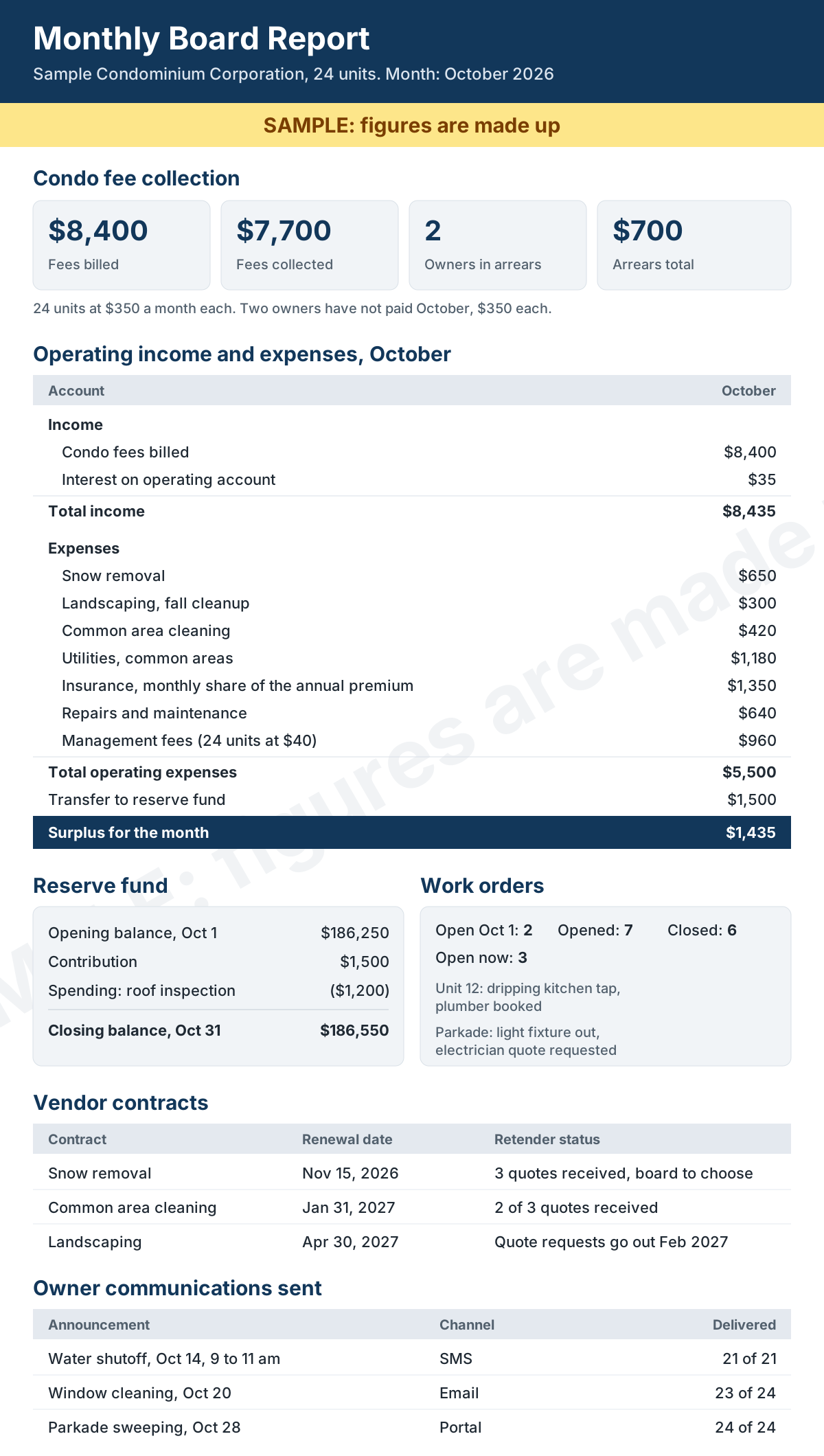 A sample report for a fictional building. Every figure in it is made up.
At year end the same records feed the financial statements, the annual reserve fund report and the written insurance report the board owes owners at the AGM. We prepare those reports as part of the monthly fee.
How owners and the board communicate and pay
Owners and board members use the Resident Center, an online portal, for payments, requests and documents. Here is what the corporation gets:
- Fee collection by EFT or card. Condo fees are set up as recurring charges on each owner's account. The board sets the rules for partial payments.
- Announcements by email, SMS and the portal. A notice can go out on any mix of the three, and email delivery is tracked per recipient, so the board has a record of who it went to.
- A board-only document folder. Files can be shared with every owner, with the board only, or with a single owner. Draft budgets, legal letters and vendor bids stay with the board.
- Architectural request tracking. Each request carries a status and a decision (pending, approved or denied), with the files attached.
- Violation notices from standard templates. A violation is logged and shared with the owner, along with the documentation and history.
- Board term records. Each board member's position and term start and end dates are on file, so a new board gets a clean handover.
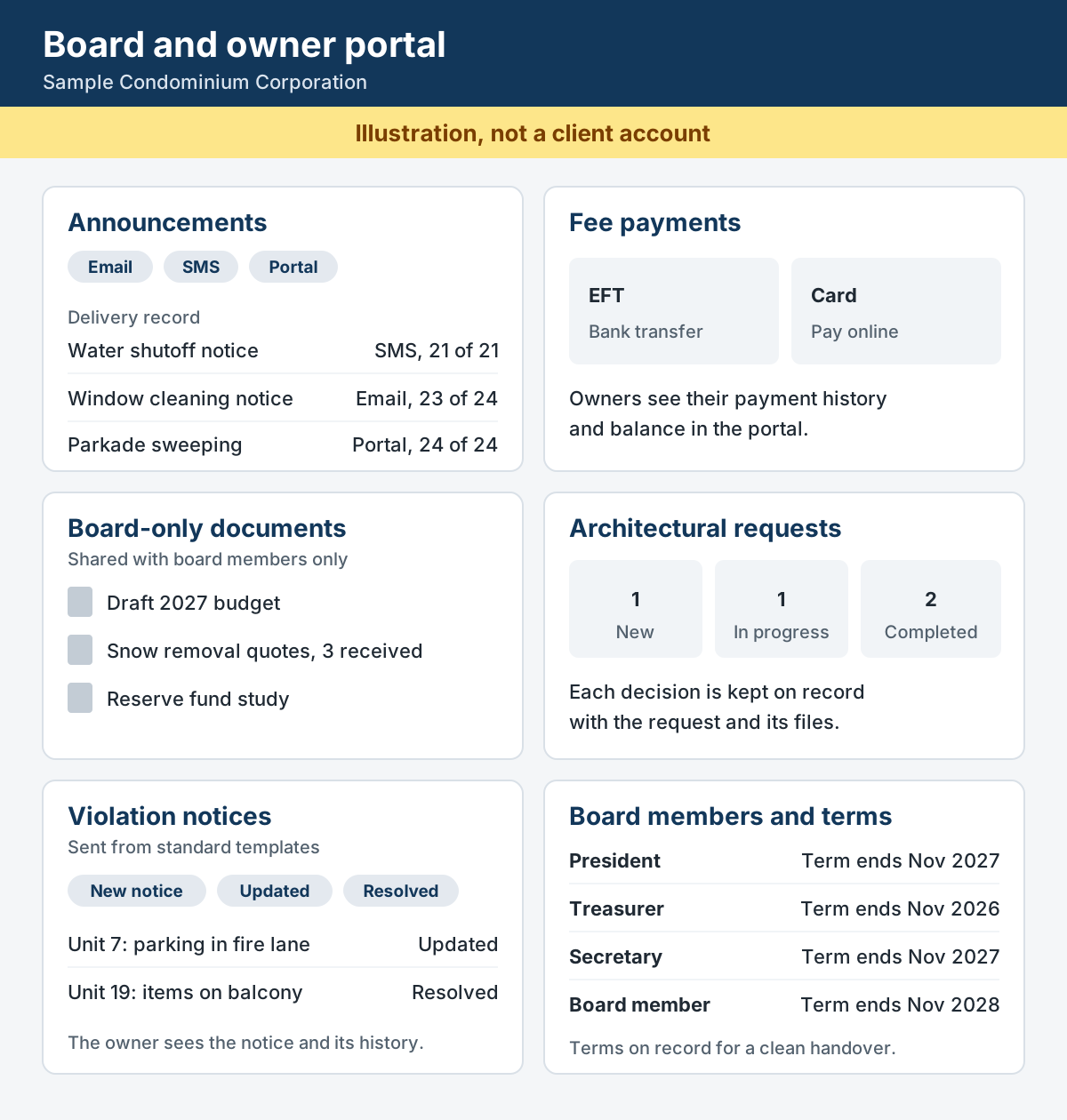 An illustration of the portal tools, not a real client account.
Every vendor contract goes out for quotes every year
Snow removal, landscaping, cleaning, repairs: every vendor contract goes back out for three quotes every year. The current vendor can bid again, but it has to bid.
When we hire, schedule and pay a vendor, the corporation pays the vendor's bill and nothing more. We add no markup. That work is part of the monthly fee.
The monthly board report lists each vendor contract with the date it was last retendered and the next date it goes out for quotes. Capital project and reserve fund study pricing is in the rate card above.
Who manages your building
Keenan George, a co-founder and owner of GoodDoors, manages condo corporations day to day with the GoodDoors team.
Sarah Halbgewachs is our broker of record. GoodDoors is a brokerage registered with the Saskatchewan Real Estate Commission. Every SREC registrant must carry errors and omissions insurance of at least $1,000,000 per claim through the Real Estate Insurance Exchange (Real Estate Regulations s 18.1(2)). We also carry commercial general liability insurance. Ask us for our certificate of insurance and for what each policy covers on condo corporation work.GoodDoors has 1,100+ doors managed since 2017.
Spending approval. We ask the board before any repair over $500, unless your management agreement sets a different amount. We write in whatever amount you choose. In an emergency we act without waiting for approval. The work appears on that month's board report with the other work orders opened and closed, and coordinating an emergency outside business hours costs $97.50 a call.The contract and how to leave it
The first contract runs 12 months, and the 60-day notice does not apply to it. After that it renews automatically for 12 months at a time, and either side can end a renewal term with 60 days' written notice. There is no fee to give notice.
When you leave, we hand over every record, account and file within 30 days, at no charge. We charge no document retention fee.
If your current agreement was signed by the developer's board. Saskatchewan law gives your corporation a specific way out. Once the board is made up of members elected after the developer stopped owning a majority of units, the corporation can end a management agreement the developer's board signed, whatever its terms say. Without cause, it cannot be ended until one year has passed from the day the parties signed it, unless the agreement allows an earlier date, and the corporation must give 60 days' written notice (Act s 29(3)). The corporation is not liable just for ending it. If your own elected board signed it. The Act's termination rule covers only developer agreements, so any other management contract ends on its own terms. Read the notice clause before you do anything else.Switching from your current manager or from self-management
The steps are the same whichever way you come to us. Setup costs $0.
- Check your current agreement. Find the term, the renewal date and the notice period, and whether notice must be in writing.
- Give notice. If you have a manager, the board sends written notice as the agreement requires. If you self-manage, the board passes the motion to hire us and signs our agreement.
- Hand over the records. Your outgoing manager or treasurer passes us the books of account, financial records, minutes, bylaws, owner list, vendor contracts and bank details. The board must keep proper books and minutes either way (Act s 39(2)), so the handover starts from what the corporation already holds.
- Set up owners in the portal. We load every owner, set up condo fees as recurring charges and send owners their portal invitations, at $0.
- Receive your first board report. Once setup is done, the board gets the monthly report described above.
What Saskatchewan law asks of your board, and what a manager can take on
These are statements of what The Condominium Property Act, 1993 and The Condominium Property Regulations, 2001 say. They are not legal advice. Your corporation's own bylaws may add to them, so check those too.
The board stays responsible. The corporation is responsible for enforcing its bylaws and for the control, management and administration of the units and common property (Act s 35(1)). Hiring a manager does not move those duties off the corporation. Each board member must use the care, diligence and skill of a reasonably prudent person (Regs App bylaw 17(4)). The board can delegate. If your corporation still uses the standard bylaws, the board may hire agents and delegate any or all of its powers and duties, subject to any restriction or direction given at a general meeting, and can take them back (Regs App bylaw 18). Owners at a general meeting can restrict or direct the board (Act s 39(1)). The AGM. It is held every year, no later than 15 months after the end of the last one (Act s 40(2)). If the board misses it, any owner can call it. Failing to hold one is an offence, with a fine of up to $2,000 for the corporation (Act s 111(1)). Documents every year. At the AGM the board presents financial statements and an annual report. It also owes owners a reserve fund report showing the year-end balance and every payment into and out of the fund (Act s 58.2(1)), and a written report on the insurance coverage after reviewing its adequacy (Act s 65(11)). Under the standard bylaws the treasurer presents a budget for the coming year (Regs App bylaw 17(3)(d)(i)). The corporation also files an annual return in Form MM, due by the last day of the month after its anniversary month (Regs s 45.1(1)(b)). The reserve fund. Every corporation must have one, with narrow exemptions (Act s 55(1), Regs s 51.7(1), Regs s 11(c)). No minimum contribution is set; the corporation decides based on expected repairs and its latest study (Regs s 51). Money in the fund is held in trust (Act s 61(2)(b)). The reserve fund study. A qualified person must do a study and written report every five years (Regs s 51.2). Corporations with fewer than 12 units, not counting parking and services units, are exempt. The cost is a common expense the board may charge to the reserve fund (Act s 58.1(7)). The study report goes to the next AGM after each study (Act s 58.1(8)). The audit. It depends on the unit count, not counting parking and services units (Regs s 53.2). Over 50 units, the statements are audited every year with no opt out. From 12 to 50 units, an audit is required unless 80% of owners consent in writing, and then a review is required unless 100% consent. Under 12 units, no audit is required, and a review is required unless 80% consent. Consent must be obtained every year (Regs s 53.2(5)(b)). What a manager can take on. We can prepare and send notices, run the meetings, keep the books, collect fees, prepare the AGM financial, reserve fund and insurance reports, tender the reserve fund study and retender vendor contracts. Two things the law keeps away from any manager: a property manager cannot audit or review the corporation's statements (Regs s 53.1(d)(iii)), and cannot hold an owner's proxy at a meeting (Act s 41.1(3)).Regina condo resources and how pricing compares
CCI South Saskatchewan, the Regina chapter of the Canadian Condominium Institute, has board resources and a membership and business directory at cci-southsaskatchewan.ca. Its member material includes condo board resources, condo cases and the CondoVoice newsletter.
When we searched on 2026-11-06, no Regina manager we found publishes a condo management price. We publish ours so a board can compare before the first call.
If your building is in Saskatoon, see our page on condo management in Saskatoon. If you own a single rental unit rather than sit on a board, our rental property management fees page is the one you want.
Questions to ask any condo manager, answered for GoodDoors
| Question | Our answer |
|---|---|
| How many meetings are included? | Up to 4 board meetings a year and the AGM. Extra meetings are $125 an hour |
| Do you mark up vendor bills? | No. The corporation pays the vendor's bill only |
| What do you charge on capital projects? | 5% of the contract on projects over $10,000, $125 an hour on smaller ones |
| What does an estoppel certificate cost? | $200, paid by the selling owner. The corporation pays nothing |
| What happens to our records if we leave? | Every record, account and file is handed over within 30 days at $0 |
| How long is the contract? | 12 months, then 12-month renewals. Either side ends a renewal term with 60 days' written notice |
| Who manages our building day to day? | Keenan George, a co-founder and owner, with the GoodDoors team |
| When do you need board approval to spend? | Repairs over $500, unless your agreement sets another amount. Emergencies are acted on without waiting |
| What insurance do you carry? | GoodDoors is a brokerage registered with the Saskatchewan Real Estate Commission, and every SREC registrant must carry errors and omissions insurance of at least $1,000,000 per claim through the Real Estate Insurance Exchange. We also carry commercial general liability insurance. Ask us for our certificate of insurance |
Frequently Asked Questions
How much does condo management cost in Regina?
We charge Regina condominium corporations $40 per unit per month, plus GST, with a $960 monthly minimum, the fee for 24 units. A 50 unit corporation pays $2,000 a month. Every other charge, from extra meetings to capital projects, is in the rate card on this page. The fees on our rental pages are for owners renting out their own units, not for condo corporations.
Is condo management priced per unit or as a flat monthly fee?
The other published condo price we found in Saskatchewan is a starting monthly fee, with the final number set by unit count and the services the board needs, so a board learns its fee only after it asks. We publish the formula, so a board can work out its fee before it calls us: unit count times $40, or $960, whichever is higher.
What does a condo management company do for the board?
It runs the corporation's day to day work under the board's direction: collecting condo fees, paying vendors, preparing the monthly board report and the AGM package, sending owner notices, and getting quotes for contracts. The board still exercises the corporation's powers and performs its duties (Act s 39(1)); hiring a manager does not change that. The rate card on this page lists what our monthly fee covers. For a corporation in Saskatoon, see condo management in Saskatoon.
What does an estoppel certificate cost in Saskatchewan, and who pays it?
The Regulations cap the fee at $200 (Regs s 66.1(2)). The certificate is issued in Form GG when an owner, or someone they authorize in writing, asks for it, and the corporation is bound by what it certifies (Act s 64). Under our management agreement the selling owner pays the $200 and GoodDoors keeps it for preparing the certificate, so the corporation pays nothing. The Act and Regulations set no deadline for issuing one.
What can the corporation charge owners for other documents?
A fee for any document the Act requires cannot exceed the corporation's cost of producing and providing it (Regs s 66). That covers resale documents such as the bylaws, financial statements, budget, reserve fund study and the management agreement.
Can we hold the AGM online?
Yes, unless your corporation's bylaws prohibit it. The Act allows an AGM by telephone, electronic or other means that let everyone communicate adequately with each other during the meeting (Act s 40(4)). The standard bylaws do not prohibit it. We run board meetings on site or online, whichever the board prefers.
Do we need a reserve fund study?
If your corporation has 12 units or more, not counting parking and services units, yes. A qualified person must do a study and written report every five years (Regs s 51.2), and a new corporation's first is due within three years of its first annual meeting (Act s 58.1(3)(a)). The cost is a common expense the board may charge to the reserve fund (Act s 58.1(7)). We tender the study and work with the qualified person as part of the monthly fee.
How do special assessments work?
The Act does not use the words "special assessment". The estoppel certificate calls it an "extraordinary contribution levied on the unit" (Form GG item 7), and fees in general become due when the corporation passes a resolution levying them (Act s 57(2)(a)). Ask your lawyer how your corporation should levy one. When a board does, we handle the notices, collection and tracking at $125 an hour.
Can we charge interest on late condo fees?
Yes. Unpaid contributions carry interest at a rate fixed by special resolution (Act s 59(1)), and the rate cannot exceed 23% a year (Regs s 66.2). The standard bylaws say the owners set the rate at the annual meeting, but the Act's special resolution requirement prevails. The corporation can also register a lien on the unit's title, enforceable like a mortgage (Act s 63(2)(b)).
Can our corporation stop owners from renting their units?
No. A bylaw cannot prohibit or restrict the lease of a unit (Act s 44(2)(a)). The corporation can require notice: the owner's intention to rent and an address for service before renting, the tenant's name within 20 days of the tenancy starting, and notice within 20 days after it ends. If a bylaw authorizes it, the corporation can also take a damage deposit, capped at the maximum security deposit under The Residential Tenancies Act, 2006 (Act s 77(1)).
Do we need an audit?
It depends on your unit count, not counting parking and services units (Regs s 53.2). Over 50 units: an audit every year. From 12 to 50 units: an audit, unless 80% of owners consent in writing; without an audit the statements must still be reviewed, unless 100% of owners consent. Under 12 units: no audit, but a review, unless 80% of owners consent. Consent must be obtained every year (Regs s 53.2(5)(b)), and your property manager can never be your auditor (Regs s 53.1(d)(iii)).
Does Saskatchewan license condo managers?
The Condominium Property Act, 1993 and its Regulations do not deal with licensing condo managers. Whether The Real Estate Act applies to condo board work is a question for SREC or a lawyer.
Separately, GoodDoors is a brokerage registered with the Saskatchewan Real Estate Commission.